
Last updated September 20, 2026
Full 25-point door and opener safety check with every visit - springs, cables, rollers, tracks, and your LiftMaster or Chamberlain opener included
You get a price before we start. It does not change when the truck arrives.
 Before
 After
After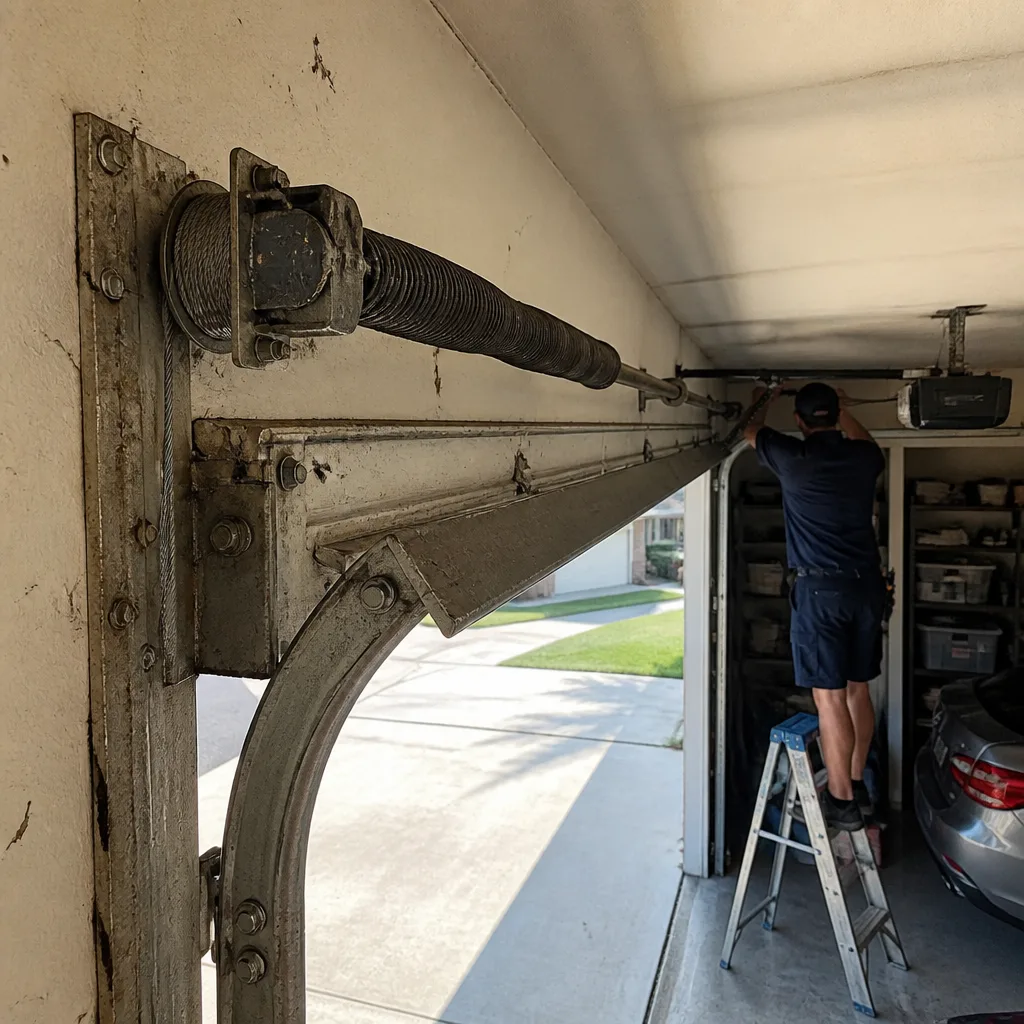 Before
 After
After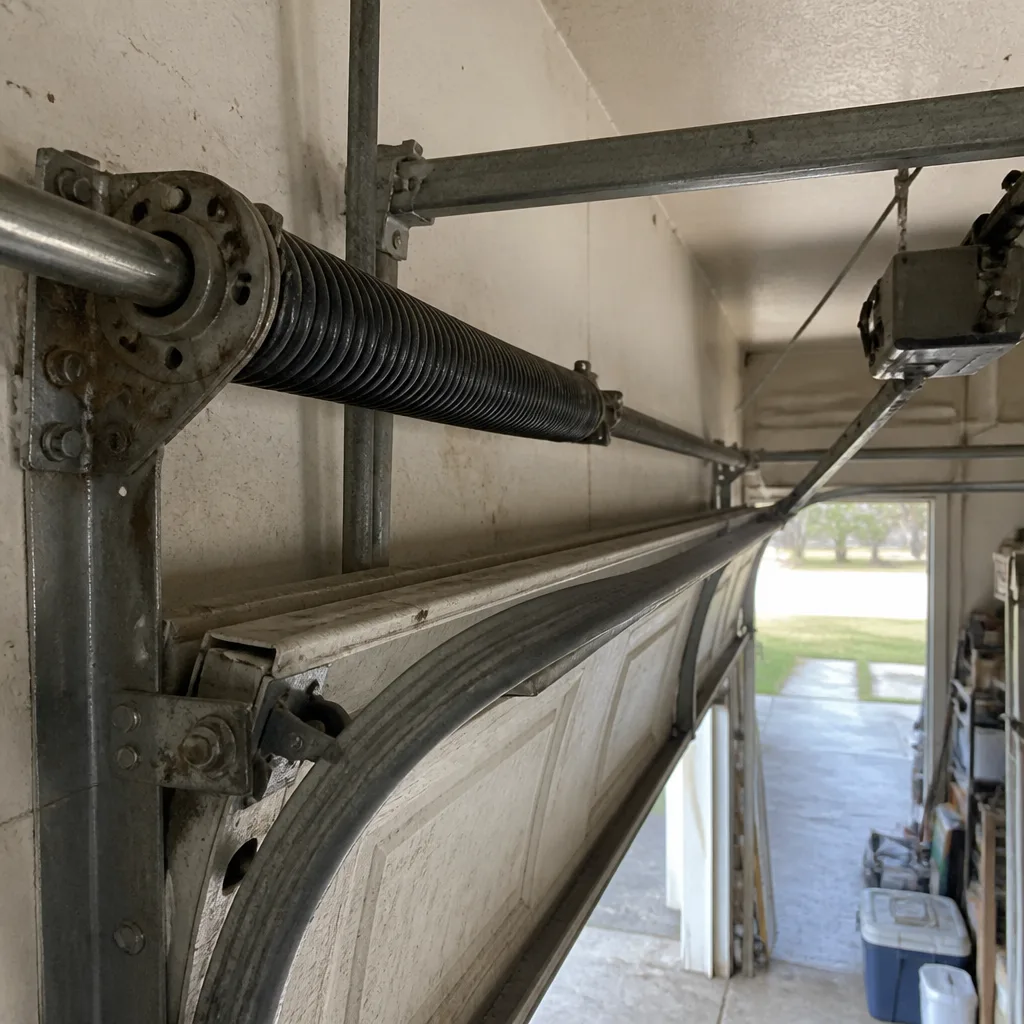 Before
 After
AfterGarage Door Warning Signs: A Bradenton Homeowner’s Reference Guide
Most garage door warning signs lists read like a horoscope: vague enough to apply to anyone, specific enough to help no one. The door “sounds funny.” The door “moves slowly.” What does any of that mean? A Bradenton homeowner facing a 7-foot, 200-pound door that suddenly behaves differently needs to know something more useful: which part is probably failing, whether it is safe to keep using the door, and whether the repair is a $40 roller or a $400 spring. This guide maps each warning sign to its probable root cause, assigns an urgency level, and explains how to photograph the problem so a technician can quote it accurately before arriving. For a deeper dive into local maintenance, see our The Complete Guide to Garage Door in Bradenton. If you live in Bradenton, the salt air, humidity, and afternoon storms are active participants in every symptom described below.
Quick Answer
The most common garage door warning signs in Bradenton are a door that reverses before closing, a visible gap in a torsion spring, a door that is noticeably heavier when operated manually, grinding or squealing during travel, and rust streaks on the door face. Any broken spring or cable means stop using the door immediately and call a professional. Worn rollers, rusty tracks, and sagging weatherstripping are schedule-within-a-week issues. For a flat written price before any work starts, call Servo Garage Doors Bradenton at (941) 203-1829.
Table of Contents
- The Door Reverses Before Fully Closing
- A Visible Gap in the Torsion Spring
- Grinding, Squealing, or a Sound Like a Train Braking
- The Door Feels Heavy When Operated by Hand
- Rust Streaks on the Door Face: What Bradenton Salt Air Does
- The Door Moves Unevenly or Binds on One Side
- The Opener Responds Slowly or Needs Multiple Button Presses
- How to Document a Warning Sign with Your Smartphone
BeforeAfterThe Door Reverses Before Fully Closing
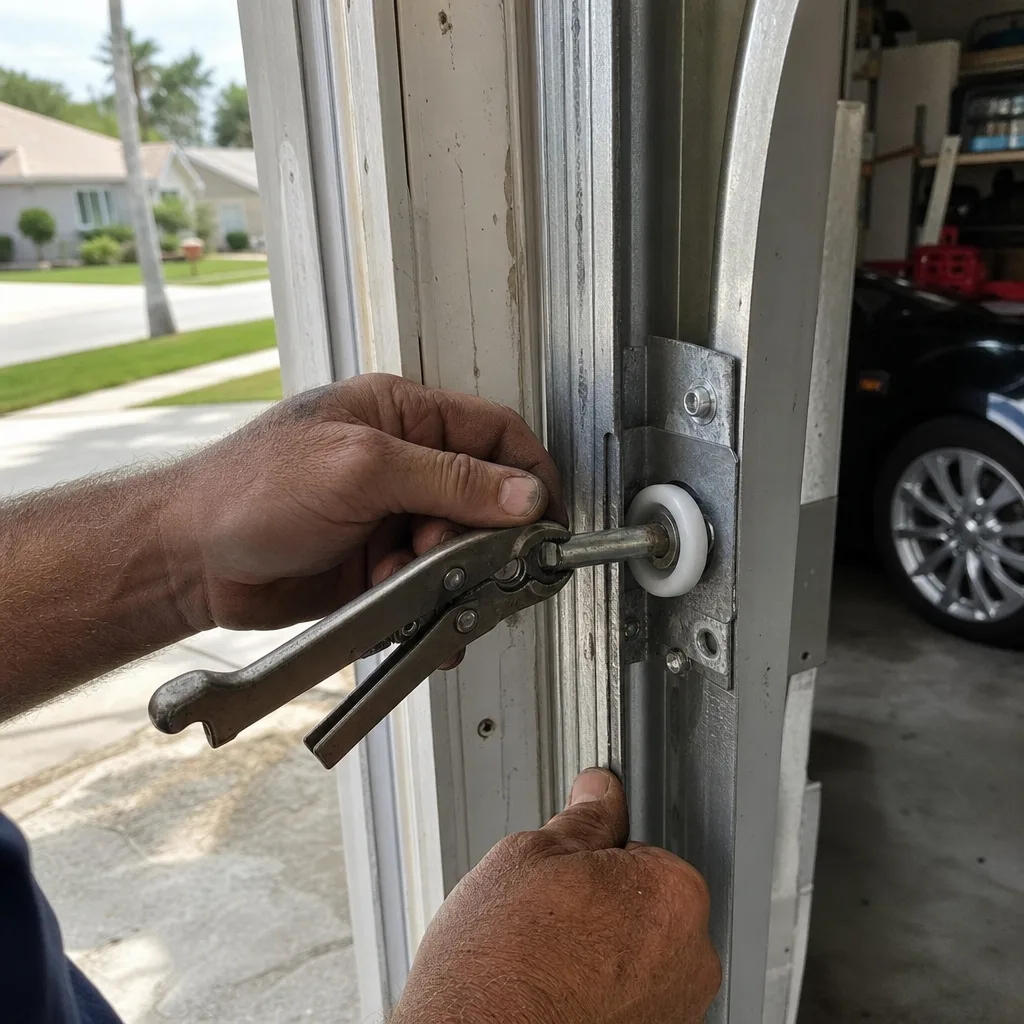
A garage door that reverses before it reaches the floor is the most commonly misdiagnosed symptom we see in Bradenton. Homeowners assume it is a sensor problem. They wipe the photo-eye lenses, align the sensors, and the door still reverses. In most cases, the reversal is the opener’s force-limit circuit doing exactly what it was designed to do: detecting resistance above a preset threshold and reversing to prevent injury or damage. The question is why the resistance is there.
In coastal Florida conditions, the two most frequent root causes are worn rollers and a bent or misaligned track. Rollers on older doors are often nylon with ball bearings that have been grinding through years of humid air and salt exposure. When a bearing seizes, the roller skids instead of rolling. That skidding creates friction. The opener’s force sensor reads that friction as an obstruction and reverses the door. A bent track does the same thing, usually at a specific point in the travel where the binding occurs.
The third common cause is an aging torsion spring that has lost tension. When spring tension drops, the opener motor has to work harder to move the door. The extra load trips the force limit, and the door reverses. Adjusting the force setting upward “fixes” the reversal by telling the opener to ignore the resistance. That removes the safety mechanism while leaving the mechanical fault in place. It also accelerates wear on the opener motor, the gear, and the spring. A technician who adjusts force settings without inspecting the door’s mechanical hardware is treating a symptom, not a cause.
Urgency: Schedule within one week if the door reverses occasionally. Stop using the door and call immediately if the reversal happens on every cycle, because the underlying friction may indicate a failing spring or a track that is about to let a roller escape.
A Visible Gap in the Torsion Spring
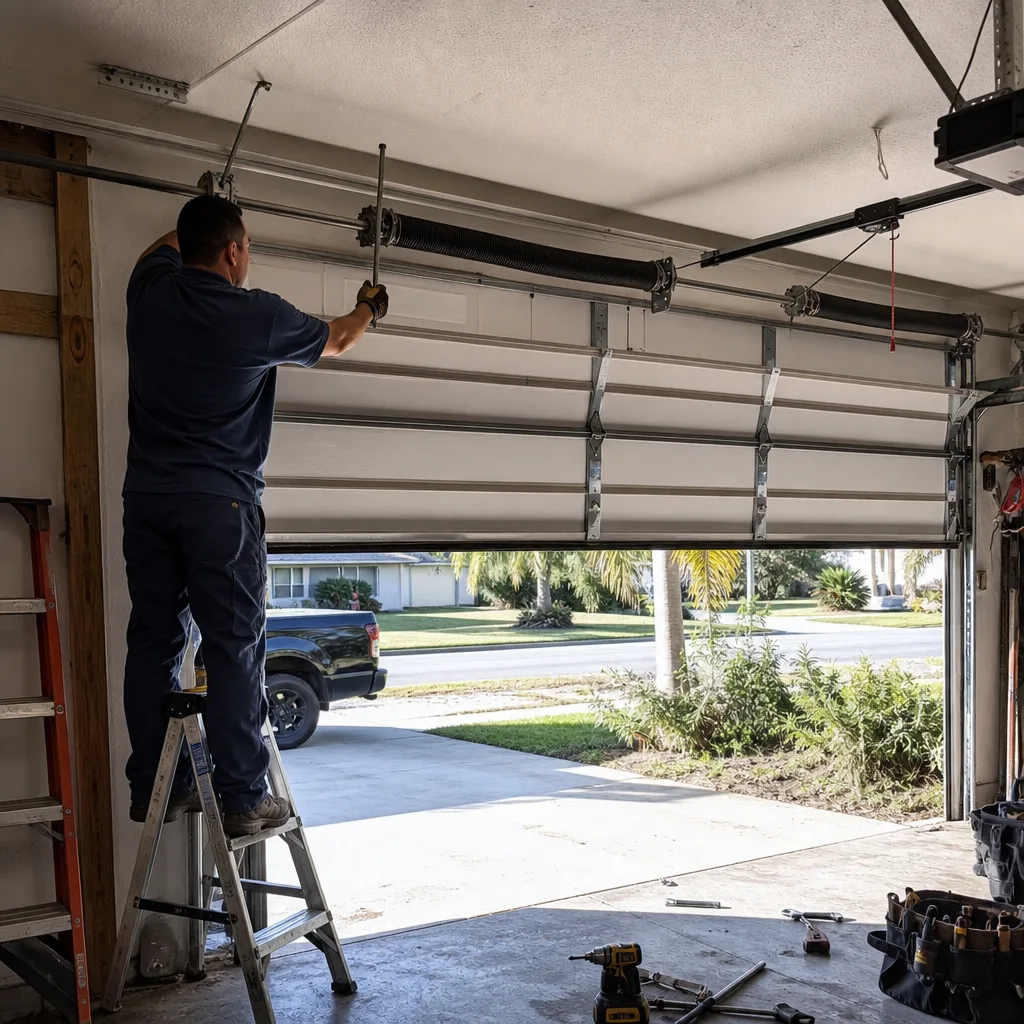
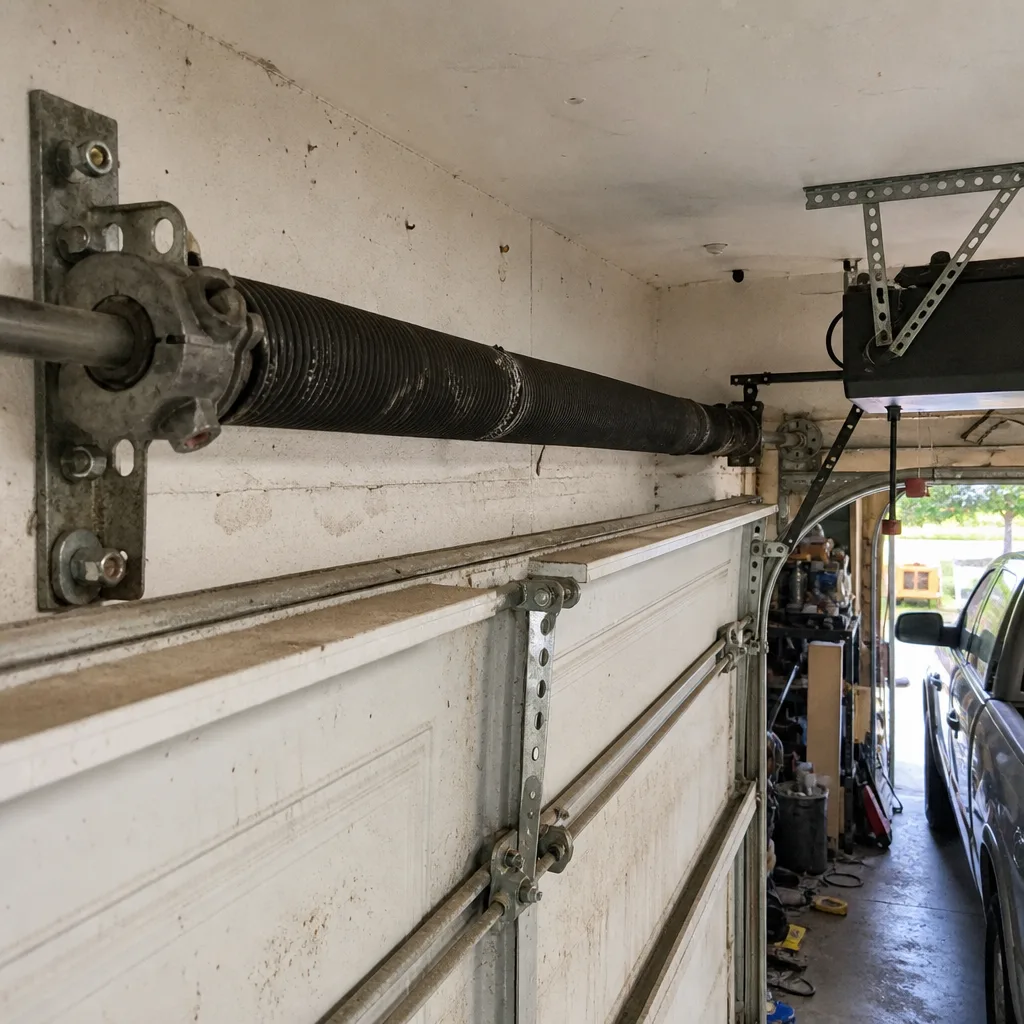
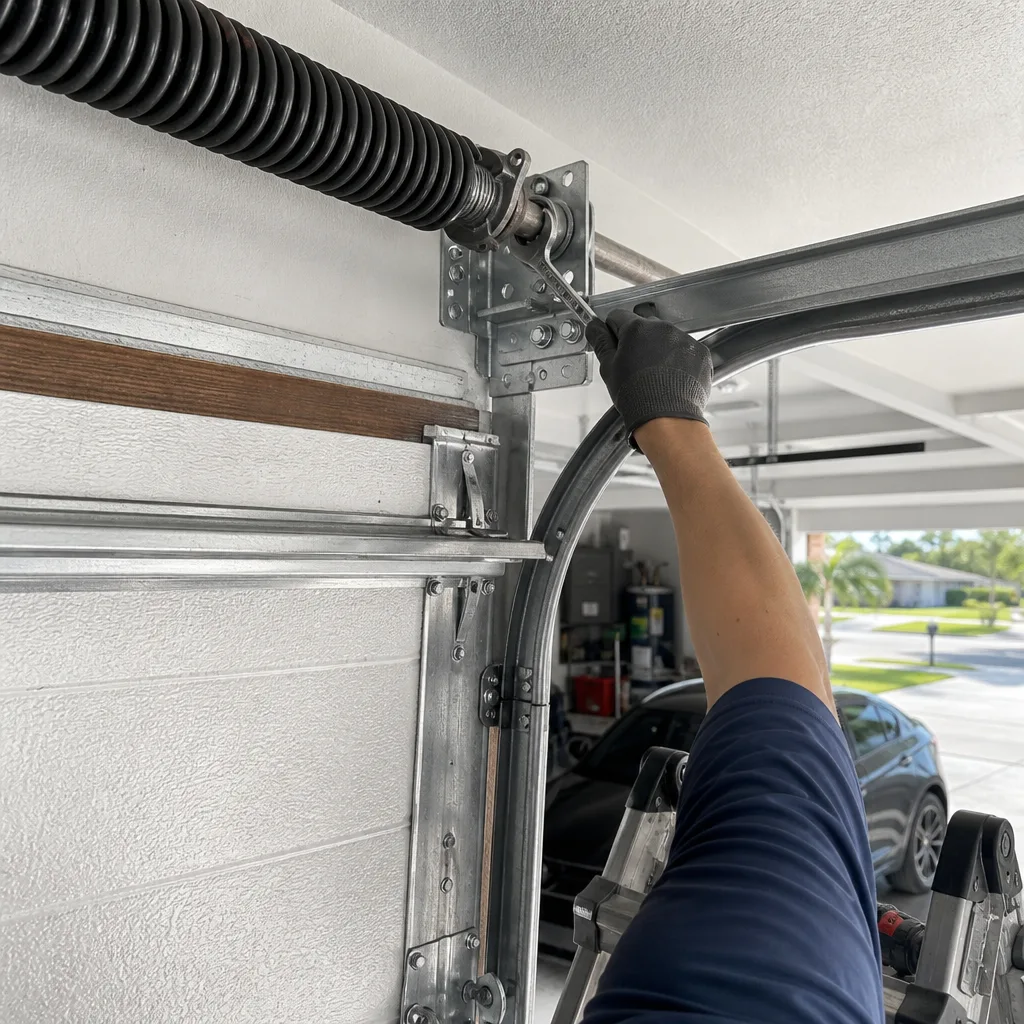
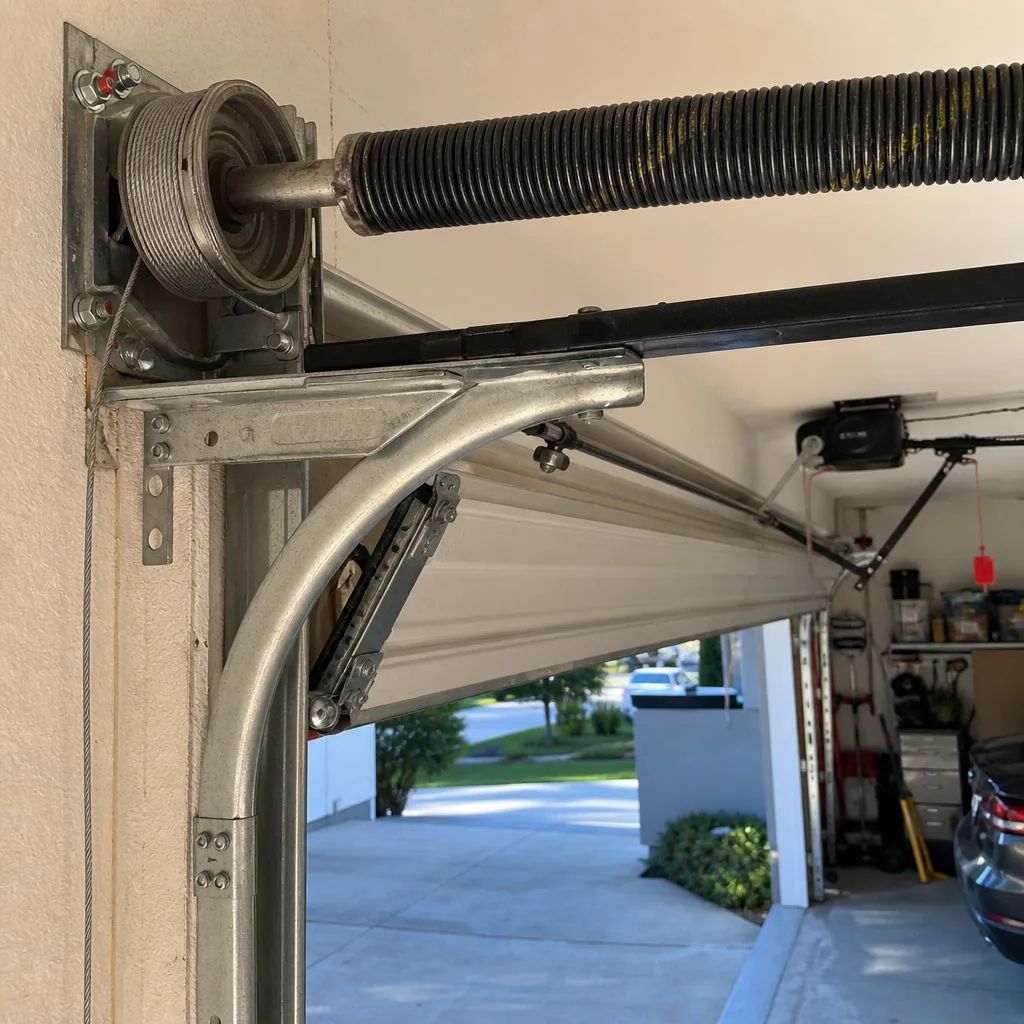
A torsion spring is the coiled steel spring mounted horizontally above the door opening. It stores the energy that counterbalances the door’s weight. When a torsion spring breaks, it breaks cleanly, usually with a sound like a gunshot inside the garage. If you look up and see a gap in the coil, about two inches wide, the spring has failed. There is no ambiguity here.
This is the highest-urgency warning sign on this list. A broken torsion spring means the door’s full weight is now uncounterbalanced. If you pull the emergency release and try to open the door manually, you are lifting 150 to 200 pounds. If the door is open when the spring breaks and you release it, it can come down hard enough to injure a person or damage a vehicle. Do not operate the door. Do not attempt to remove or adjust the spring yourself. Torsion springs are under high tension, even when broken, and the winding process requires specific tools and training. A spring that unwinds unexpectedly can cause serious injury.
In Bradenton, spring failures are more common than in drier climates. The combination of humidity and salt air accelerates corrosion on the spring wire, even on oil-tempered springs. We frequently see springs that are only five or six years old with surface pitting that eventually concentrates stress and causes a premature break. If you see a gap in the spring, photograph it, close the garage door if it is safe to do so, and call (941) 203-1829.
Urgency: Stop using the door immediately.
Grinding, Squealing, or a Sound Like a Train Braking
Noise is a warning sign only when the noise changes. Every garage door makes some sound. A door that has always had a low rumble is not necessarily failing. A door that suddenly develops a high-pitched squeal, a rhythmic grinding, or a metallic scrape is telling you something specific.
Here is how to decode the sound in Bradenton conditions:
- High-pitched squeal that follows the door’s travel: This is almost always a dry or failing roller bearing. Nylon rollers with sealed bearings eventually lose their lubrication. In humid air, the bearing races corrode and the roller squeals. Replacing all rollers is a $120 to $180 job in Bradenton and usually resolves the noise completely.
- Rhythmic grinding that matches the panel joints: This is often a roller that has seized and is now skidding along the track. The track develops flat spots. If this continues, the roller can jump the track entirely.
- Metallic scrape, louder near the top of the travel: This usually indicates a track that has shifted or a door that is out of balance and dragging against the track wall. On coastal homes in Bradenton, we also see hinge screws that have corroded and loosened, allowing the door panels to shift and scrape against each other.
- Loud bang when the door starts moving: This is often the opener’s gear or sprocket slipping under load. The opener is working harder than it should, usually because the spring has weakened or a roller has seized.
The opener itself is rarely the source of a grinding noise. In our experience, nine out of ten noise complaints trace back to the door’s mechanical hardware. Replacing the opener does not fix a seized roller. The noise just migrates to the new motor, which now has to work harder to overcome the same friction.
Urgency: Schedule within one week. A seized roller can become a derailed door without much additional warning.
The Door Feels Heavy When Operated by Hand
Testing a garage door by hand is the single most useful diagnostic a homeowner can perform. Pull the emergency release cord while the door is closed, then lift the door manually to about waist height and let go. A properly balanced door stays where you leave it. It feels almost weightless. A door that drifts down or feels like it weighs 80 pounds has a spring problem.
Here is the step-by-step diagnosis:
- Close the door fully.
- Pull the red emergency release cord. This disconnects the opener carriage from the door.
- Lift the door slowly to waist height.
- Release the door gently.
- Observe. A healthy door stays at waist height. A door with a weakened spring drifts downward. A door with a broken spring cannot be lifted without significant effort and may slam down if released.
If the door feels heavy but the spring looks intact, the spring has likely lost tension through normal fatigue. Torsion springs in Bradenton are typically rated for 10,000 cycles, which translates to roughly seven to ten years of normal use. If your home was built between 2015 and 2018 and the original spring is still in place, you are inside or approaching the replacement window. A weakened spring does not need to break to cause problems. It forces the opener to work harder, which shortens the opener’s life and increases energy draw. Replacing the spring before it breaks is cheaper than replacing a spring plus an opener gear.
Urgency: Schedule within one week if the door drifts down. Stop using the door if it cannot be lifted at all.
Rust Streaks on the Door Face: What Bradenton Salt Air Does
Not all rust on a garage door is cosmetic. The pattern of the rust tells you which internal component is corroding. In Bradenton, where salt air from the Gulf moves inland and humidity regularly exceeds 80 percent, rust streaks are not a question of if but when. The useful question is what the streak pattern reveals.
Here is how to read the streaks:
- Vertical streaks originating from the bottom panel edge: Water is pooling inside the bottom panel, usually because the bottom weatherstripping has failed and storm-driven rain is entering. The panel’s internal steel stile is rusting from the inside. This weakens the panel over time and can eventually cause the bottom section to sag or split. The fix is replacing the weatherstripping, which is an inexpensive repair in Bradenton, typically $80 to $120 installed.
- Streaks radiating from hinge points or roller brackets: The hardware is corroding. In coastal conditions, zinc-plated hinges last only a few years before surface rust appears. When the hinge pins corrode, the panels bind. Replacing all hinges and brackets on a typical two-car door costs $150 to $250 and is worth doing before a hinge fails outright.
- Horizontal streaks across the door face following panel lines: This is usually cosmetic surface rust on the steel skin, but it can indicate that water is wicking between panels from the inside. If the door is more than a decade old and shows horizontal streaking, the panel insulation may be holding moisture, which accelerates rust from the back side of the skin.
- Rust at the bottom corners of the track: This is normal for Bradenton garages, especially those within a few miles of the Manatee River or the Gulf. The track is not failing when the corners rust. But if the rust extends more than six inches up the track, the track may have lost structural integrity and should be evaluated.
Document any rust pattern you notice. A dated photo taken every few months is more useful than a one-time image, because it shows whether the corrosion is progressing or stable.
Urgency: Monitor and log if the rust is stable. Schedule within one week if streaks are new or growing, especially around the bottom panel.
The Door Moves Unevenly or Binds on One Side
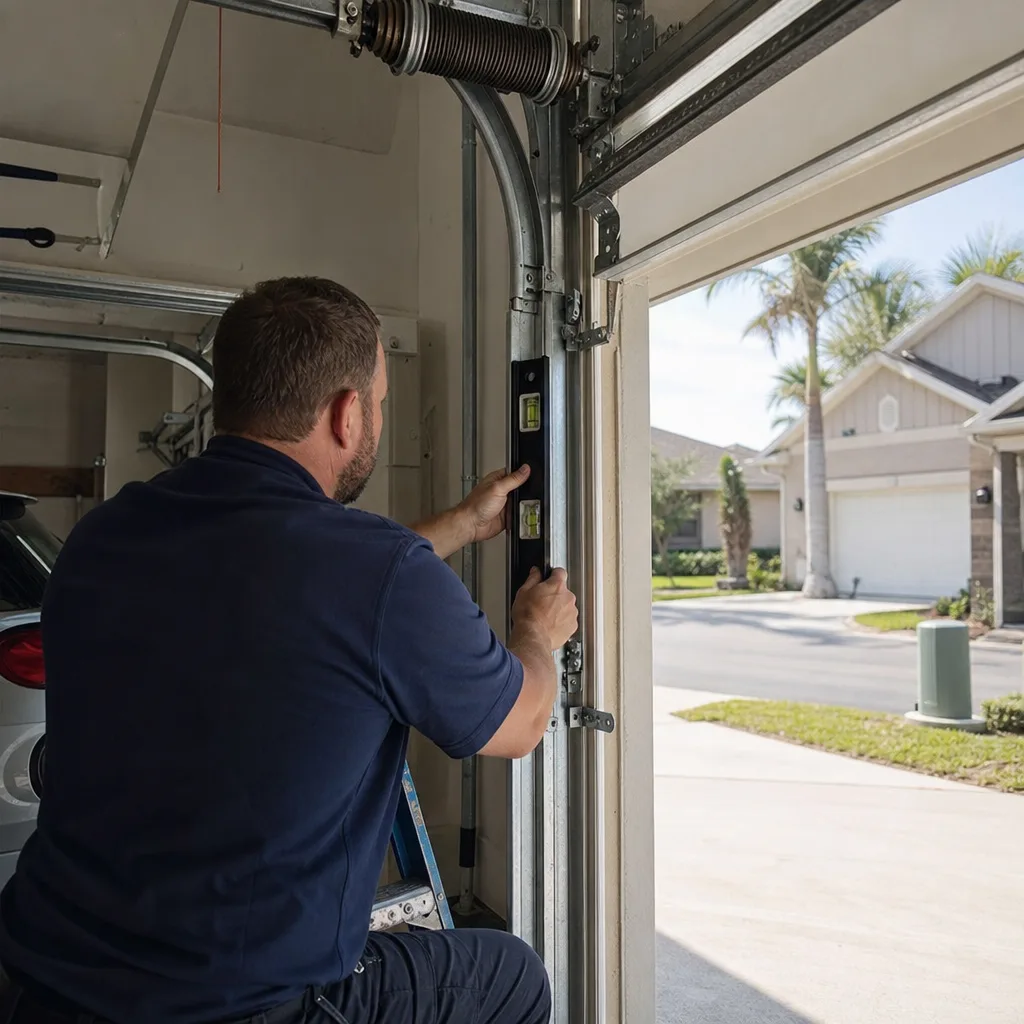
A garage door that tilts, shudders, or stalls on one side during travel is usually a cable or track problem. The door is suspended by two cables, one on each side, connected to the torsion spring assembly. When one cable stretches or begins to fray, that side of the door drops slightly. The door twists in the opening. Rollers bind against the track. The opener strains.
In Bradenton, cable fraying is common on doors that face south or west and get afternoon sun through an open garage. The cables are galvanized steel, but the UV exposure and humidity shorten their life. A frayed cable looks like a wire brush near the bottom bracket. If you see broken strands, the cable is close to failure. When a cable fails while the door is moving, the door can drop suddenly on that side, bending the track, damaging the panels, and potentially injuring anyone underneath.
An uneven door can also be caused by a track that has come loose from its mounting brackets. The track bolts work loose over time, especially on older Bradenton homes with concrete block walls where the original anchors were poorly set. If you can see daylight between the track and the wall bracket, or if the track moves when you push on it, that is a mounting failure, not a door failure. The repair is straightforward: reseating the track and replacing the anchors.
Urgency: Stop using the door if it tilts visibly during travel. Schedule within one week if the binding is intermittent.
The Opener Responds Slowly or Needs Multiple Button Presses
An opener that hesitates after you press the wall button or remote is often an electrical issue, but not always in the opener itself. In Bradenton’s humid climate, corrosion on the logic board is a real problem, especially in garages that are not climate controlled. The board traces corrode, and the opener’s brain becomes unreliable. It may take two or three presses to respond. It may open but not close. It may intermittently ignore the safety sensor input.
However, slow response can also originate elsewhere. A wall button with corroded contacts produces intermittent signals. A remote with a dying battery produces weak signals. A circuit breaker that is marginally undersized for the opener produces voltage drops during startup, which the logic board reads as a fault. Before replacing the opener, ask a technician to test the outlet voltage and inspect the wall button. In some Bradenton homes built during the 2015-to-2020 construction boom, we have seen openers on shared 15-amp circuits with other garage loads. The opener works, but it works marginally.
Five warning signs that are commonly misdiagnosed as opener problems but originate in the door hardware, saving the cost of an unnecessary opener replacement:
- A door that reverses before closing: Usually friction or spring tension, not the opener’s force setting.
- A grinding noise during travel: Usually rollers or track, not the opener’s gear.
- A door that stops halfway: Usually a binding track or a failing spring, not the limit switch.
- A door that is slow to open: Usually a weakening spring or worn rollers, not the opener motor.
- A door that slams on the way down: Usually a broken spring or failed cable, not the opener’s down-force setting.
Before you authorize an opener replacement, get a written diagnosis that names the failed component. Clause 4 of The Haven Standard is built around this exact scenario: the technician photographs the failed part before quoting a replacement.
Urgency: Schedule within one week. An intermittent opener is not an emergency, but it will not fix itself.
How to Document a Warning Sign with Your Smartphone
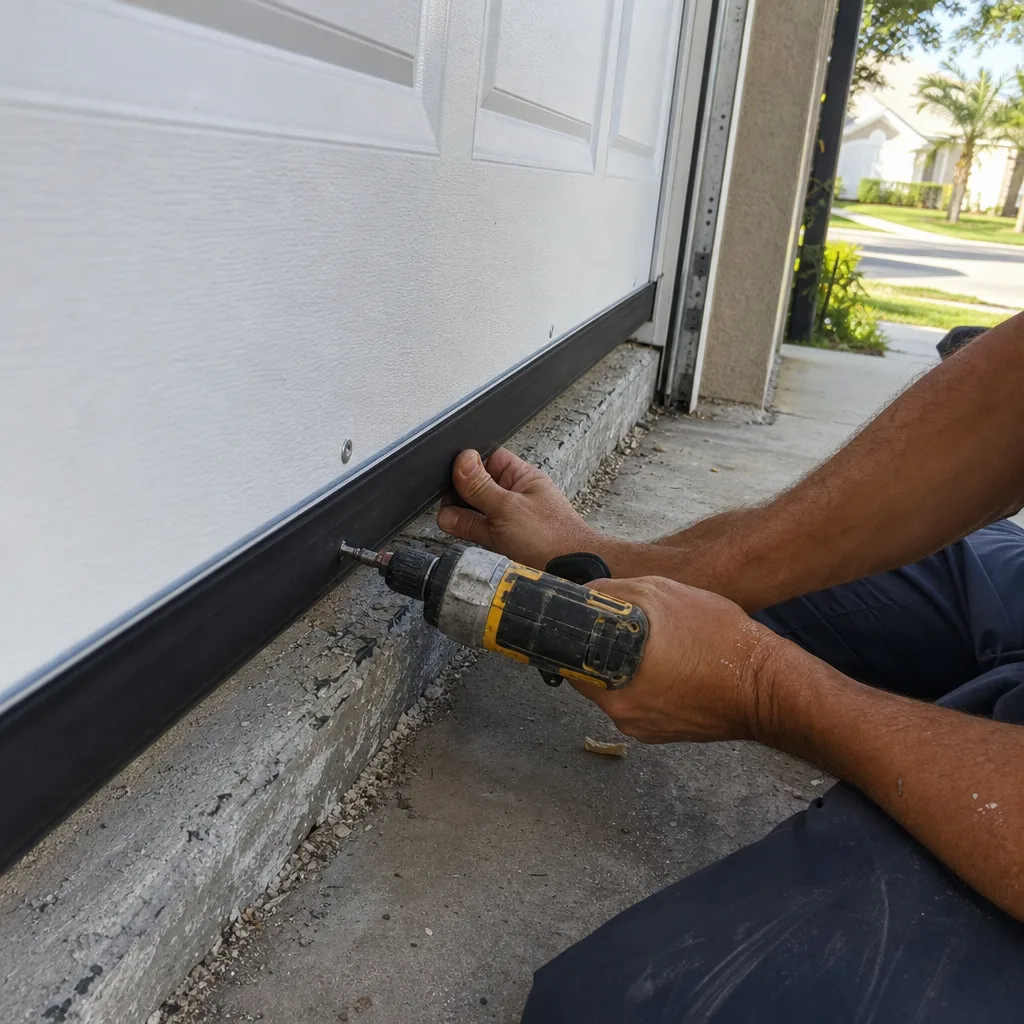
A dated photo changes the conversation with a technician. Instead of describing a noise, you are showing evidence. Here is how to capture useful documentation:
- Stand back and photograph the entire door from the driveway. Both tracks should be visible. This gives the technician a baseline for track alignment and panel condition.
- Photograph the torsion spring assembly from directly below. Aim the camera up at the spring. If there is a gap, make sure the gap is centered in the frame. Do not touch the spring or climb on anything to get the shot.
- Photograph each bottom cable bracket. The cables attach at the bottom corners of the door. Fraying shows up best at close range with the flash on.
- Photograph any rust streaks at panel joints or hinge points. Use the flash even in daylight. Rust colors wash out in bright sun.
- Photograph the door from the inside at mid-travel. Open the door halfway using the opener, then pull the release. Photograph the rollers in the track. Seized rollers show flat spots and skid marks on the track.
- Take a short video of the door moving through one complete cycle. Stand at the front corner so the camera captures both the top and bottom of the door. Even three seconds of video tells a technician more than a paragraph of description.
Store the photos on your phone with a filename or album that includes the date. When you call Garage Door Repair in Bradenton, mention that you have photos and can text them. A technician who sees the spring gap or the rust pattern before arriving can bring the right parts and quote a flat written price on site.
Common Mistakes to Avoid
- Adjusting the opener’s force setting to stop a reversal. The reversal is the safety system doing its job. Overriding it masks the friction or spring problem and removes the protection. This is the single most common mistake we correct on Bradenton doors.
- Lubricating rollers, hinges, and springs with WD-40. WD-40 is a solvent, not a lubricant. It strips existing grease and accelerates wear. Use a silicone-based garage door lubricant on hinges and springs, and replace sealed rollers rather than lubricating them.
- Operating the door with a visible spring gap “just one more time.” A door with a broken spring can come down unpredictably. Every cycle risks bending a track, cracking a panel, or injuring a person.
- Ignoring a frayed cable because the door still opens. The cable is the only thing counterbalancing the door on that side. When it lets go, the door drops. The repair cost after a cable failure is often three to four times the cost of replacing the cable before it fails.
- Painting over rust streaks without checking what is underneath. Rust streaks at the bottom panel edge indicate water intrusion. Painting the face hides the symptom while the internal steel keeps rotting. Fix the weatherstripping first.
- Waiting until the door fails completely to call for service. A Bradenton homeowner who schedules a roller replacement for $150 avoids a derailed door that costs $400 to $600 to reset, with a possible panel replacement on top.
- Calling for opener replacement when the door hardware is the problem. Ask for a written diagnosis that names the component before authorizing any replacement. The Garage Door Opener Repair & Installation in Bradenton page explains what to expect.
When to Call a Professional
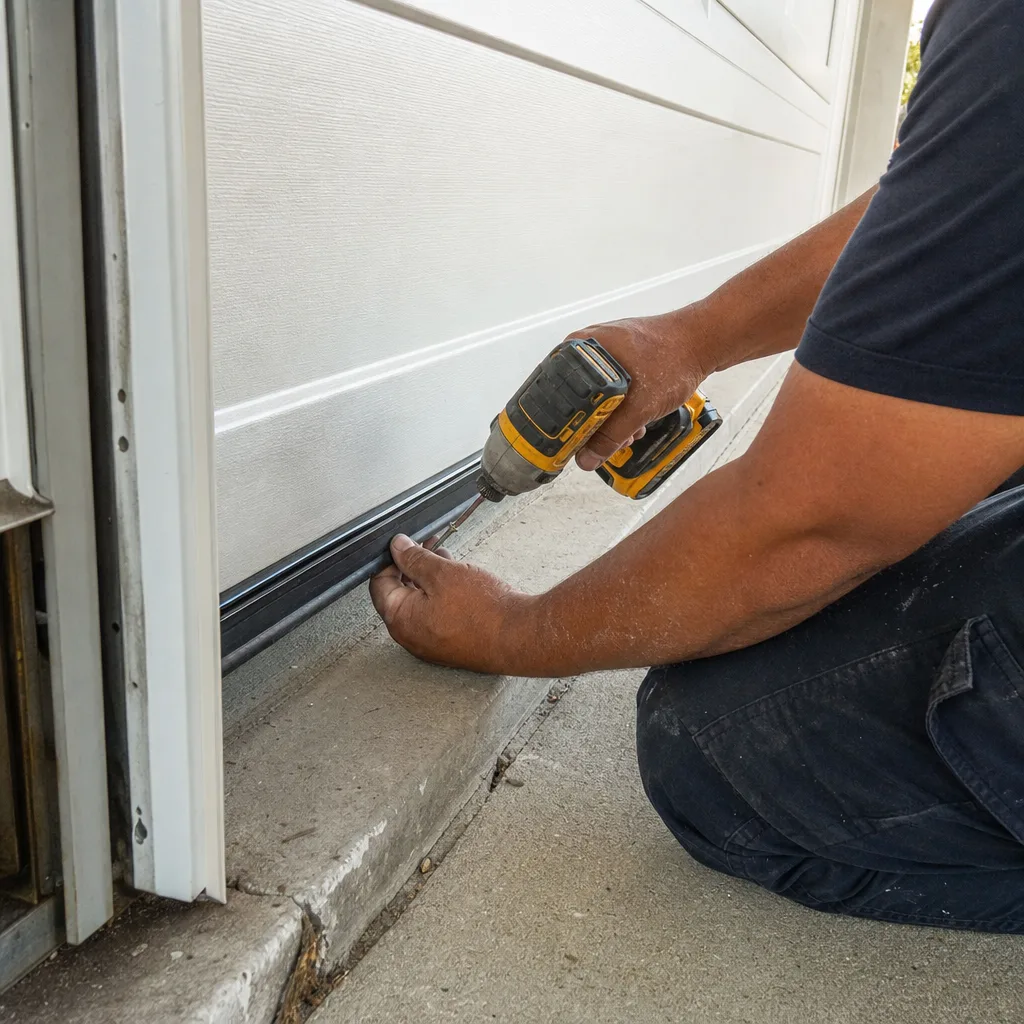
Call a professional immediately if you see a gap in the torsion spring, a broken or frayed cable, or if the door tilts visibly during travel. These are stop-use conditions. Call within a week for grinding noises, slow travel, rust streaks that are growing, or a door that drifts when released manually. Call if you have adjusted the opener force setting and want the underlying mechanical cause diagnosed properly. Servo Garage Doors Bradenton offers free estimates in Bradenton, with a flat written price and written scope delivered before any work starts, per Clause 1 of The Haven Standard. Explore more guides & resources on our blog. Call (941) 203-1829.
Frequently Asked Questions
Torsion spring replacement in Bradenton typically costs $180 to $340 for a single spring on a standard two-car door, including the spring, labor, and balancing. Dual-spring doors run $250 to $450. The price is quoted in writing before any work starts. Call (941) 203-1829 for an exact quote.
Yes, in most cases. A broken spring is a stop-use condition, and we treat it as a priority call. Our live phone line is answered 24/7 at (941) 203-1829, and a technician typically arrives with the correct spring for your door’s weight and size. The price is agreed in writing before work begins.
No. The flat written price is delivered before any work starts and is based on the written scope. If additional work is needed, it is quoted separately in writing before proceeding. That is Clause 1 of The Haven Standard.
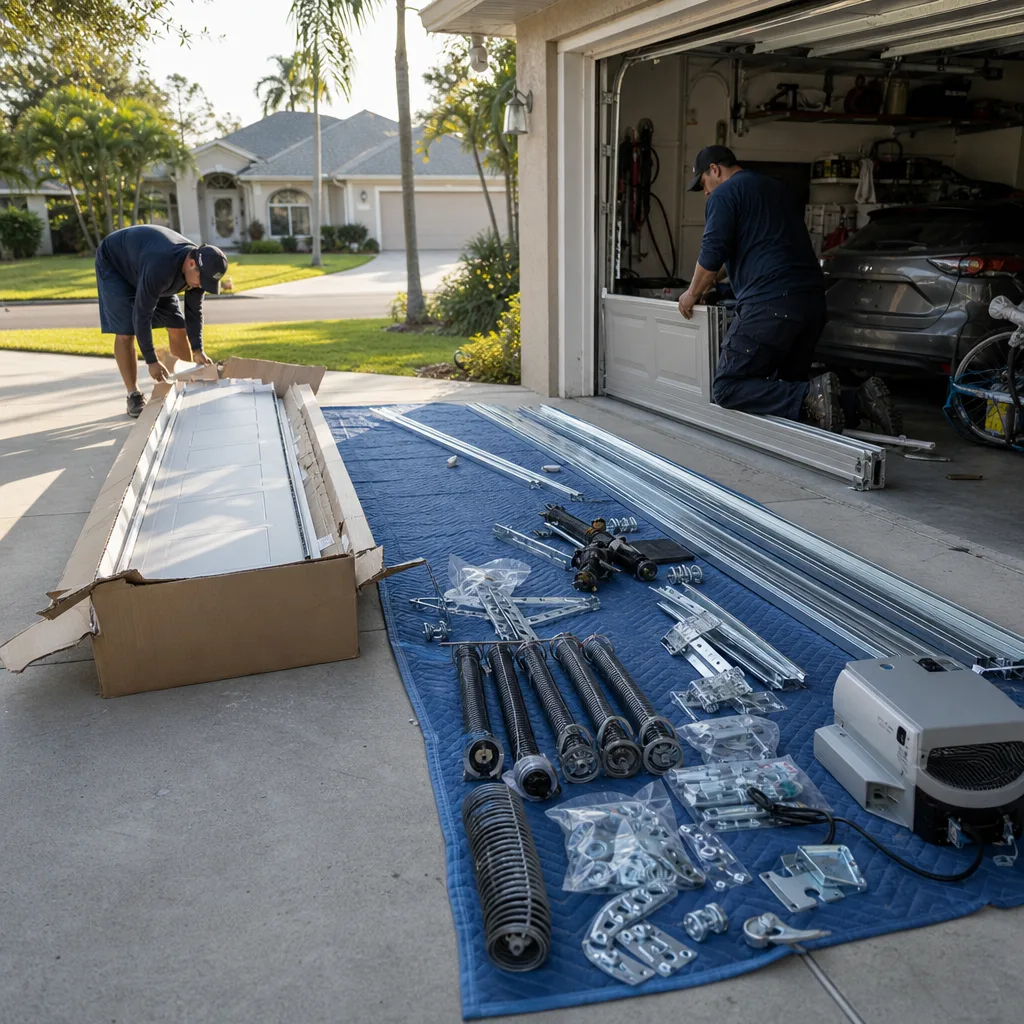
Yes. Our trucks carry torsion springs across common weight ratings, rollers, hinges, cables, weatherstripping, and opener gears for LiftMaster and Chamberlain units. Most Bradenton repair calls are completed in one visit.
Sealed nylon rollers last five to seven years in Bradenton’s humidity and salt air. Steel rollers without bearings last three to five years. If the door is noisy or the rollers show flat spots, replacement is overdue. A full roller replacement on a two-car door costs $120 to $180.
Check that nothing is blocking the photo-eye sensors at the bottom of the track, then attempt one manual close by holding the wall button down continuously. If the door still refuses to close or reverses repeatedly, the force-limit circuit is detecting friction, and the door should remain unused until the cause is identified. Call (941) 203-1829 for a free estimate.
The Bottom Line
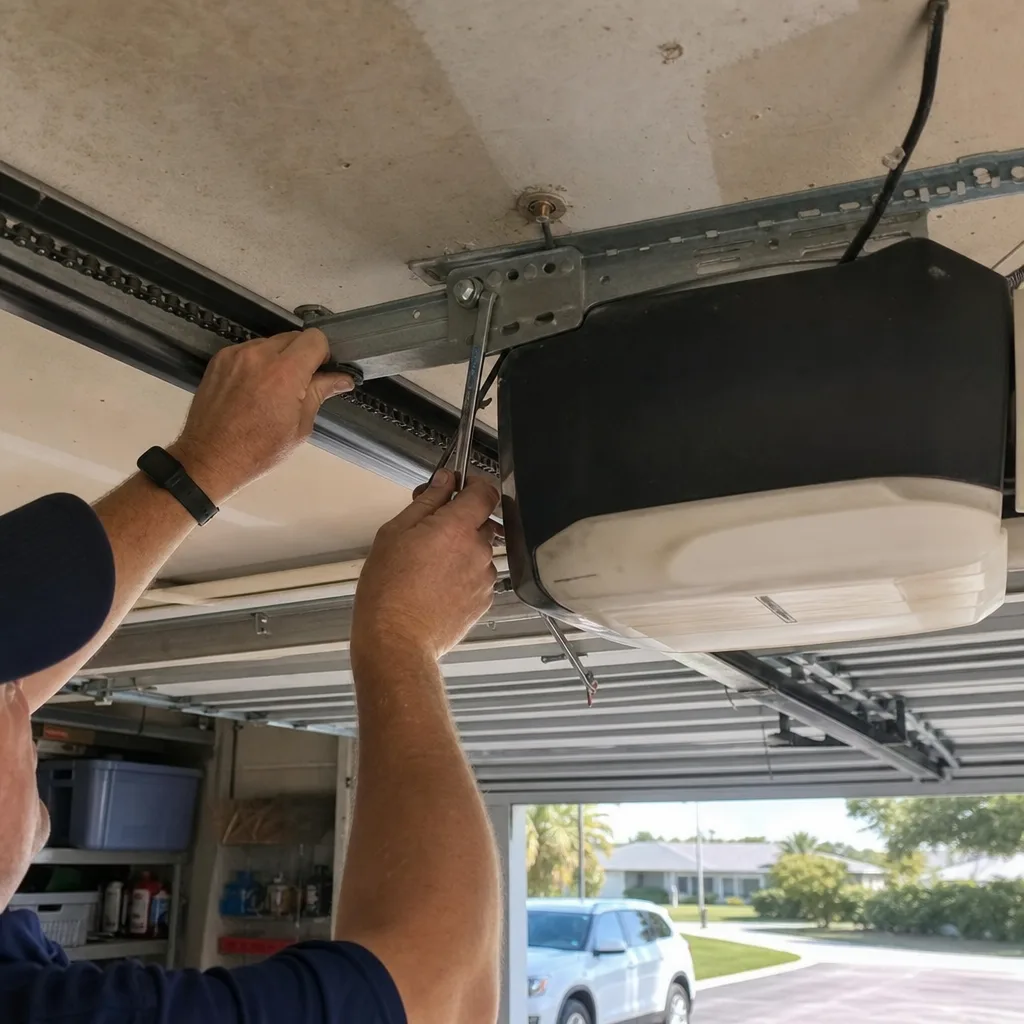
A garage door warns you before it fails. The reversal, the squeal, the rust streak, the heavy manual lift: each symptom maps to a specific component, and each component has a known failure pattern in Bradenton’s coastal climate. The urgency level matters more than the symptom itself. A broken spring is a stop-use emergency. A frayed cable is close behind. Worn rollers and declining spring tension are schedule-within-a-week issues. The goal is to catch the five-dollar weatherstripping before the water gets to the $900 panel, and to catch the $180 roller set before the door derails and takes the track with it. For more on what a repair or replacement involves, see our Servo Garage Doors Bradenton home page or the Garage Door Installation in Bradenton guide. If your door is showing any of the signs above, call (941) 203-1829. The estimate is free, the price is written, and the photos are included.
Written by Marcus Deller, Owner at Servo Garage Doors Bradenton, serving Bradenton since 2015.